%20(1)-1.jpg)
14 June to 13 September 2026
"Flowers for the Dignified Mouse"
How we made the exhibition of dignified mice with Sulev Kuuse
Small briefing by Tuuli Puhvel
To tell everything honestly, we could start with the fact that a few years ago, Edith Hermann, the head of the Pallas Library at the Estonian Academy of Arts, invited Sulev and me to make an exhibition of the Prima Vista art program about Tibet, where we had both visited at different times. Collages were created from Sulev´s photos and my painted backgrounds, but the main thing was that the collaboration was nice and fun, it left a beautiful memory and a slight ambition that we could try doing something together again.
Another important event was last fall, when Sulev´s partner Pille invited us - along with Sulev, me and my husband Eero - to her place to try out plant printing or botanical dyeing. After a short period of hiding, I realized that I had contracted a more serious infection, and now for two autumns I have been steaming potfuls of pretzels made from plant leaves, fabrics and plastic wrap over a fire.
Finally, we arrive at the exhibition that Sulev had agreed to hold at the Promenaadiviis cultural club a year ago in November 2025 in Tartu, and which we had no choice and plans but to do something together by the beginning of last September.
The idea of putting fabrics already printed with plants on frames and then starting to move forward step by step became a good idea. My plan was that the thematic and substantive side would be based on Sulev´s field of expertise: biology, scientific drawings, cells, laboratory mice. Plants are already the background.
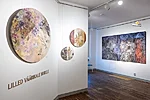
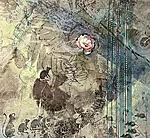
First, we picked up watercolor pencils and drew and wrote drawings and text excerpts from Sulev´s University-time notes on the works. Then we did the same in some places using the diatype technique (drawing on a plate covered with printing ink while drawing on the other side of the fabric). In some places, we also simply painted with acrylic paints and used perforated stencils a little. Then, Sulev cut out three or four different mouse figures from linoleum and bravely and dignifiedly printed them on the works. The pictures with the labyrinth and swing have been printed using wooden blocks. And then it was especially fun when we found a rag bag and stuck pieces (or half an umbrella) onto the works and embroidered them or cottone thme to the canvas. Sulev turned out to be an incredibly good embroiderer, practicing the over-the-bar stitch and the fir-tree stitch with special skill.
This is how the exhibition was completed in two months. Not a single day was left over, but not a single day was missing either. The collaboration was creative and fun. When one of us ran out of ideas or a jacket, the other always had a plan in his pocket. Of course, we were supported by the strong background forces Pille and Eero. However, Daniel Keyes´ book Flowers for Algernon, which Sulev and I both read avidly, became a character in this entire creative story. It is the story of a mentally retarded man, Charlie Gordon, who undergoes an experiment to increase his intelligence. The prototype of the experiment is a laboratory mouse, Algernon, on whom the procedure works successfully. But the effect is temporary and the mouse soon dies. Finally, Charlie Gordon, who has become highly intelligent, also falls into a fading state, leaving as his last request to place flowers on the grave of Algernon the Mouse. This story had such an impact on the authors of the exhibition years later that it was decided to name the exhibition, paraphrasing the title of D. Keyes´ short story.
The next thing that happened was that Mare Hunt from Kondas Centre came to Tartu last
autumn to the opening of our exhibition at Promenaadi 5, and very nicely invited Sulev and I to have an exhibition with our works in Viljandi. We of course graciously accepted the invitation, we did some more work in 2026 and here we are now.
Tuuli Puhvel
Sulev Kuuse
"Flowers for the Dignified Mouse"
How we made the exhibition of dignified mice with Sulev Kuuse
Small briefing by Tuuli Puhvel
To tell everything honestly, we could start with the fact that a few years ago, Edith Hermann, the head of the Pallas Library at the Estonian Academy of Arts, invited Sulev and me to make an exhibition of the Prima Vista art program about Tibet, where we had both visited at different times. Collages were created from Sulev´s photos and my painted backgrounds, but the main thing was that the collaboration was nice and fun, it left a beautiful memory and a slight ambition that we could try doing something together again.
Another important event was last fall, when Sulev´s partner Pille invited us - along with Sulev, me and my husband Eero - to her place to try out plant printing or botanical dyeing. After a short period of hiding, I realized that I had contracted a more serious infection, and now for two autumns I have been steaming potfuls of pretzels made from plant leaves, fabrics and plastic wrap over a fire.
Finally, we arrive at the exhibition that Sulev had agreed to hold at the Promenaadiviis cultural club a year ago in November 2025 in Tartu, and which we had no choice and plans but to do something together by the beginning of last September.
The idea of putting fabrics already printed with plants on frames and then starting to move forward step by step became a good idea. My plan was that the thematic and substantive side would be based on Sulev´s field of expertise: biology, scientific drawings, cells, laboratory mice. Plants are already the background.
First, we picked up watercolor pencils and drew and wrote drawings and text excerpts from Sulev´s University-time notes on the works. Then we did the same in some places using the diatype technique (drawing on a plate covered with printing ink while drawing on the other side of the fabric). In some places, we also simply painted with acrylic paints and used perforated stencils a little. Then, Sulev cut out three or four different mouse figures from linoleum and bravely and dignifiedly printed them on the works. The pictures with the labyrinth and swing have been printed using wooden blocks. And then it was especially fun when we found a rag bag and stuck pieces (or half an umbrella) onto the works and embroidered them or cottone thme to the canvas. Sulev turned out to be an incredibly good embroiderer, practicing the over-the-bar stitch and the fir-tree stitch with special skill.
This is how the exhibition was completed in two months. Not a single day was left over, but not a single day was missing either. The collaboration was creative and fun. When one of us ran out of ideas or a jacket, the other always had a plan in his pocket. Of course, we were supported by the strong background forces Pille and Eero. However, Daniel Keyes´ book Flowers for Algernon, which Sulev and I both read avidly, became a character in this entire creative story. It is the story of a mentally retarded man, Charlie Gordon, who undergoes an experiment to increase his intelligence. The prototype of the experiment is a laboratory mouse, Algernon, on whom the procedure works successfully. But the effect is temporary and the mouse soon dies. Finally, Charlie Gordon, who has become highly intelligent, also falls into a fading state, leaving as his last request to place flowers on the grave of Algernon the Mouse. This story had such an impact on the authors of the exhibition years later that it was decided to name the exhibition, paraphrasing the title of D. Keyes´ short story.
The next thing that happened was that Mare Hunt from Kondas Centre came to Tartu last
autumn to the opening of our exhibition at Promenaadi 5, and very nicely invited Sulev and I to have an exhibition with our works in Viljandi. We of course graciously accepted the invitation, we did some more work in 2026 and here we are now.
Tuuli Puhvel
Sulev Kuuse


